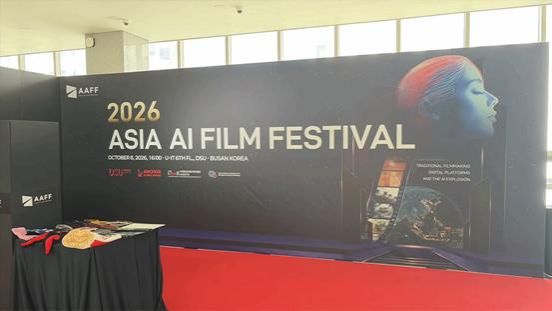
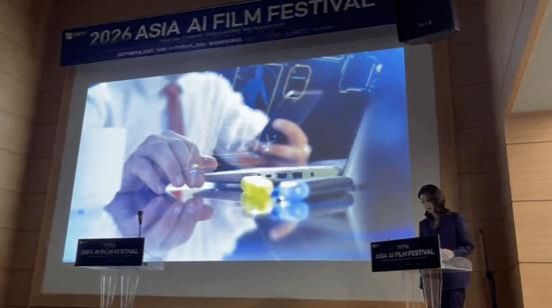
On October 8, the 2nd Asia AI Film Festival 2026 (AAFF 2026) was held in Busan, South Korea. The festival brought together 145 works from 20 countries and regions, including China, South Korea, the United States, the United Kingdom, France, and Japan. A total of 21 final projects from the Digital Media Art course, taken by the Class of 2024 in the Network and New Media program, were shortlisted. Mr. Hou Zhengdong attended the event as a representative of Cheung Kong School of Journalism and Communication.
The festival attracted participation from numerous domestic and international universities as well as professional art institutions. Through film screenings, professional reviews, and international exchanges, the festival explored the new forms, new languages, and new possibilities of cinematic creation against the backdrop of the rapid development of generative artificial intelligence.
This shortlisting is an extension project of the final coursework for the Digital Media Art course at Cheung Kong School of Journalism and Communication. The course aims to explore the boundaries where technology and aesthetics converge, and to present pioneering experiments in imaging and interactive storytelling. Focusing on "AIGC-empowered digital content production," the course actively organizes and supports students in AI-driven film creation and international exchange, exploring the integration of generative artificial intelligence with cinematic narrative, visual design, digital media, and new film production workflows. It seeks to incorporate AI technology into diverse forms of film and television expression from the perspective of young creators.
Zhou Jiani, a professor of the Film and Visual Effects program at Dongseo University in South Korea, noted that as one of the key participating universities at this year's AAFF, the student works from Shantou University demonstrated creative awareness, a spirit of experimentation, and adaptability to the rapidly changing technological environment, showing great development potential. She particularly noted that
the students did not merely use artificial intelligence as an image or video generation tool, but rather attempted to integrate it into script conception, visual design, shot expression, and the overall film production process.
The shortlisting of the Digital Media Art course works from the 2024 cohort at AAFF 2026 not only provided an international platform for our students to showcase their AI-driven film creation achievements, but also further expanded the college's exchanges with domestic and international universities, creators, and professional teams in the fields of film and television, digital media, and artificial intelligence.
Looking ahead, as artificial intelligence technology and film and television art continue to integrate more deeply, our college will continue to follow new developments in digital imaging and intelligent media, encourage young students to engage in experimental, innovative, and internationally oriented creative practices, and, against the backdrop of an era in which new technologies are constantly reshaping the way images are produced, explore an imaging language and development path that belongs to a new generation of creators.
Text by: Liu Liting, He Junxi
Images by: Festival Organizing Committee

